> For the complete documentation index, see [llms.txt](https://docs.orch.so/llms.txt). Markdown versions of documentation pages are available by appending `.md` to page URLs; this page is available as [Markdown](https://docs.orch.so/chats/chats-basics.md).
# Chats Basics
Chats is the place where your team communication lives and turns into action
## Overview
One of the core ideas of Orchestra is that ***team communication is the foundation for all further work***: every idea, task, project, or goal begins with communication. Orchestra is designed to make communication structured and reduce friction between messaging and task tracking.
As the result:
* Team **communication** becomes **structured and manageable**;
* **Information** from messages **never gets lost** in chats and is **always available** in the relevant tasks and projects;
* **Employees** are **no longer overloaded and distracted** by irrelevant messages.
Because we believe that communication is central at all work, we have created a **comprehensive and flexible chat structure** in Orchestra. This structure helps efficiently distribute communication across all team activities.
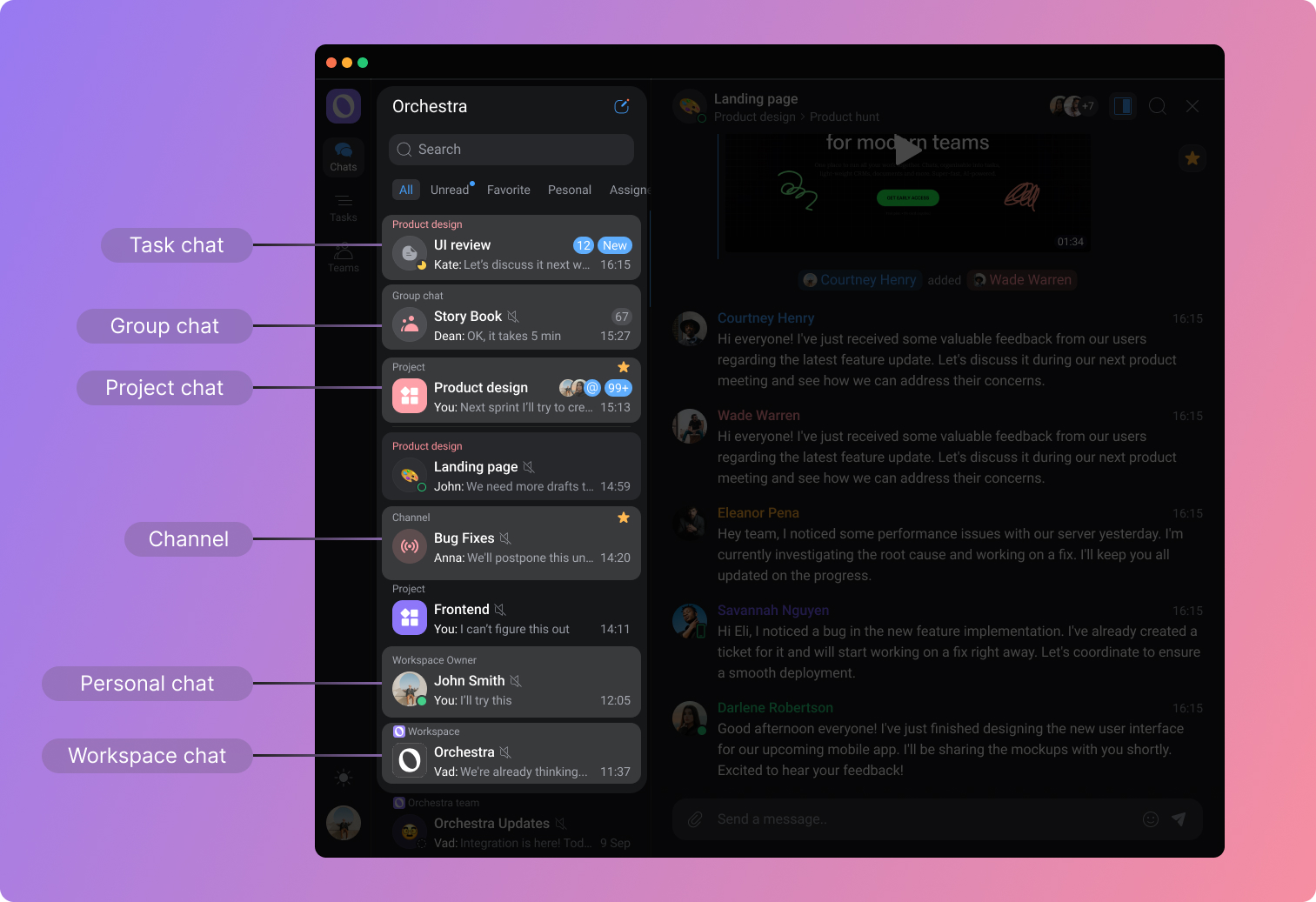
Orchestra offers 7 types of chats:
1. **Workspace chat:** Brings all workspace members together in one place. *Use it for company-wide news, updates, and any discussions that involve everyone in the workspace*.
2. **Project chat:** Dedicated to each project in Orchestra. It’s the space for project members to *collaborate, discuss common questions, share project-related information, and provide updates relevant to the project*.
3. **Task chat:** Every task in Orchestra comes with its own chat, where only those directly involved with the task can communicate. It’s the most commonly used chat type, *perfect for focused discussions and updates related to the task at hand.*
4. **Team chat:** Team members can be grouped into teams, each with its own chat. This is where team members can discuss any topics or issues relevant to their specific team, making it *easy to collaborate within a smaller group.*
5. **Personal chat.** This chat is for one-on-one communication between two workspace members. Perfect for private conversations, quick questions, or discussions that don’t require involving a group. *Personal chats are cross-workspace, meaning they remain accessible across all workspaces that the two members share.*
6. **Group chat:** Not tied to any specific project or task. It’s a space for casual conversations, team bonding, or any work-related discussions that don’t need to be confined to a particular task or project. *Use this chat for general communication or informal discussions among team members.*
7. **Channel:** A space where members can view messages, but only designated publishers can post updates. It’s *ideal for sharing company-wide news, announcements, kudos, customer feedback, or any information that needs to be broadcast without open discussion.*
With these diverse chat options, Orchestra ensures that communication flows smoothly across all levels of your organization — from task-specific conversations to workspace-wide announcements.
Select the right chat type based on your needs and keep your team connected and informed.
## Navigating Chats
Since chats are a core entity in Orchestra, they **can be opened across all major Orchestra pages**: [Chats Page](/pages-and-ui-elements/chats-page.md), [Tasks Page](/pages-and-ui-elements/tasks-page.md), [Teams Page](/pages-and-ui-elements/teams-page.md). Also, you can **open chats from the global blocks**: [Info Sidebar](/pages-and-ui-elements/info-sidebar.md) and [Chat Sidebar](/pages-and-ui-elements/chat-sidebar.md).
### Open Сhat on Chats Page
On the **Chats page**, you will find all chats you have access to. There are several ways to **open a chat** on the Chats page:
* From[Chats Page](/pages-and-ui-elements/chats-page.md#chat-list). Left-click on any chat.
* From [Chats Page](/pages-and-ui-elements/chats-page.md#chat-block)
* Right-click on a mention ([Key Messages Features](/chats/key-messages-features.md#mentions)), in opened [Context Menu](/pages-and-ui-elements/context-menu.md) select `Open chat`;
* Right-click on a member name or avatar, in opened [Context Menu](/pages-and-ui-elements/context-menu.md) select `Open chat`.
### Open Сhat on Tasks Page
On the **Tasks Page**, you can access several types of chats:
* **Project chat:** Hover over a project in the [Tasks Page](/pages-and-ui-elements/tasks-page.md#projects-block) and click the `chat icon` that appears. Alternatively, you can right-click on the project and select `Open Chat` from the context menu.
* **Task chat:** Hover over a task in the [Tasks Page](/pages-and-ui-elements/tasks-page.md#tasks-section), and click on the `chat icon` that shows up. Another way to open a task chat is by right-clicking the task and choosing `Open Chat` from the context menu.
* **Team chat:** Hover over a team in the [Tasks Page](/pages-and-ui-elements/tasks-page.md#teams-block) and click the chat icon. You can also right-click on the team and select `Open Chat` from the context menu.
You can also **access chats on the Tasks page** through the Info and Chat sidebars.
### Opening a Сhat on the Teams Page
On this page, you can open the following chat types:
* **Team chat:** Hover over a team in the [Teams Page](/pages-and-ui-elements/teams-page.md#teams-block) and click the `chat icon`. Alternatively, right-click on the team and select `Open Chat` from the context menu.
* **Personal chat:** To open a chat with a teammate, hover over the member in the [Teams Page](/pages-and-ui-elements/teams-page.md#members-section) and click the `chat icon` . Alternatively, right-click on the member and select `Open Chat` from the context menu.
You can also **open chats on the Teams page** using the Info and Chat sidebars.
### Opening a Chat from the Info Sidebar
* Left-click on the chat icon in the top right corner of the sidebar;
* In the [Info Sidebar](/pages-and-ui-elements/info-sidebar.md#info-tab)
* Right-click on a field value with a “chat” type (e.g., Project or Parent chat field). In the [Context Menu](/pages-and-ui-elements/context-menu.md) that appears, select `Open chat`. Learn more about field types: [Fields](/projects/fields.md)
* In the Projects, Tasks, Subtasks, and Related tasks blocks at the bottom of the Info tab.
* In the [Info Sidebar](/pages-and-ui-elements/info-sidebar.md#members-tab). Right-click on a member name or avatar, in opened [Context Menu](/pages-and-ui-elements/context-menu.md) select `Open chat`.
### Opening a Chat from the Chat Sidebar
* Right-click on a mention, in opened [Context Menu](/pages-and-ui-elements/context-menu.md) select `Open chat` ;
* Right-click on a member name or avatar, in opened [Context Menu](/pages-and-ui-elements/context-menu.md) select `Open chat` .
## Creating a Chat
* Click the `Create New Chat` icon in the top right corner of the left sidebar;
* In the dropdown menu, choose the type of chat you want to create;
* Enter a name for the chat and press Enter.
## Renaming a Chat
You can **rename any chat** in the following ways:
* From [Chats Page](/pages-and-ui-elements/chats-page.md#chat-header)
* Open the chat you want to rename;
* Double-click on the chat name;
* Edit the chat name and press `Enter` on your keyboard;
* From the [Info Sidebar](/pages-and-ui-elements/info-sidebar.md) header
* Open the Info sidebar of the chat you want to rename;
* Click on the chat name;
* Edit the chat name and press `Enter` on your keyboard.
## Deleting a Chat
There are several ways to **delete a chat**:
* From [Chats Page](/pages-and-ui-elements/chats-page.md#chat-list)
* Find the chat you want to delete;
* Right-click on the chat;
* In the context menu choose `Delete`;
* Click `Yes` to confirm;
* From the [Chats Page](/pages-and-ui-elements/chats-page.md#chat-header)
* Open the chat you want to delete;
* Right-click on the [Chats Page](/pages-and-ui-elements/chats-page.md#chat-header);
* In the opened context menu choose `Delete`;
* Click `Yes` to confirm;
* From the [Info Sidebar](/pages-and-ui-elements/info-sidebar.md)
* Left-click on the `...` icon in the top right corner of the [Info Sidebar](/pages-and-ui-elements/info-sidebar.md);
* In the opened context menu choose `Delete`;
* Click `Yes` to confirm.
## Joining a Chat
If you are an Owner or Editor of an entity in Orchestra, you have access to its chats, even if you're not a member. Here’s how to **join a chat**:
* Open the chat you want to join by searching for it in the[Chats Page](/pages-and-ui-elements/chats-page.md#chat-list) or clicking on a chat mention in the[Chats Page](/pages-and-ui-elements/chats-page.md#chat-block);
* Click the `Join` button at the bottom of the [Chats Page](/pages-and-ui-elements/chats-page.md#chat-block).
## Leaving a Chat
You can **leave a chat** in several ways:
* From the [Chats Page](/pages-and-ui-elements/chats-page.md#chat-list)
* Find the chat you want to leave;
* Right-click on the chat;
* In the opened context menu choose `Leave` ;
* From the [Chats Page](/pages-and-ui-elements/chats-page.md#chat-header)
* Open the chat you want to leave;
* Right-click on the [Chats Page](/pages-and-ui-elements/chats-page.md#chat-header);
* In the opened context menu choose `Leave` ;
* From the [Info Sidebar](/pages-and-ui-elements/info-sidebar.md)
* Left-click on the `...` icon in the top right corner of the [Info Sidebar](/pages-and-ui-elements/info-sidebar.md);
* In the opened context menu choose `Leave` .